
The Monsoon Session of Parliament will commence from 20 July, 2026. Legislative and financial business will be taken up for discussion. The Opposition will raise several issues of public importance and the treasury benches will defend the Union Government’s performance. When Parliament was adjourned sine die in April after the completion of the 2026 Budget Session, the Union Ministry of Parliamentary Affairs put out a press note containing a summary of the business conducted in both Houses. Further, PRS (Parliamentary Legislative Research) also published a note on the Vital Stats of Parliament’s functioning during this session. We also watched the live telecast of the debates and discussions and the pandemonium that took place inside Parliament. Large parts of the media reported on the live proceedings and the statistical summaries that were published about the business conducted in Parliament, without attempting a detailed assessment.
This is our maiden attempt to present an assessment of the attendance record of members of Parliament. In recent years, civil society and media outlets have been publishing performance reports for MPs prior to general elections to the Lok Sabha. We are not attempting anything so ambitious. We have examined the attendance record as available on the website of both Houses for the 2026 Budget Session to spot political party-wise trends and patterns. We have also tried to compare their attendance record from the point of view of the States and Union Territories they represent. Our study has thrown up clear trends that citizens have the right to know.
In this study report, we have deliberately avoided calling out individual MPs by name for their performance because neither praising nor naming and shaming anybody is our purpose. Readers may use the attached data tables to arrive at their own judgement about the attendance record of each MP.
This study report is divided into the following segments:
Introduction
I. Why is the attendance record of MPs important?
II. Duration of the 2026 Budget Session
III. Performance of MPs in the Lok Sabha
A. Political party-wise findings
B. State and UT-wise findings
IV. Performance of MPs in the Rajya Sabha
A. Political party-wise findings
B. State and UT-wise findings
Conclusion
This is a sample of the key findings from our study:-
Lok Sabha
- Less than one half i.e., 45.76% of the MPs whose attendance record is publicly available, had attended between 90-100% of the sittings or at least signed the attendance register for those many days during the Budget Session. If attendance of 75% of the sittings is taken as the minimum threshold, then 309 MPs reached it, which is 63.98% of the total;
- Among the regional political parties with more than 20 MPs in the House, AITC averaged only 15 sittings and the DMK with 22 MPs averaged even lesser with 14.64 sittings;
- Among the States and UTs with more than two MPs, Uttarakhand topped the list with the highest average no. of days of attendance (30.5 days) recorded per MP, followed by NCT-Delhi (30 days), Rajasthan (29.75 days), Himachal Pradesh (28.75 days) and Uttar Pradesh (28.69 days). Andhra Pradesh is the only State from the southern part of the country to figure in the top-10 list with its MPs averaging 27.41 days in terms of their attendance record. None of the States from the eastern part of the country figure in the top-10 list. Assam figures at the bottom of the pile with an average attendance record of 15.69 days;
- Among the States and UTs with just one or two MPs whose attendance record is available, the representatives of Chandigarh and Lakshadweep topped the list as they attended 100% of the sittings.
Rajya Sabha
- 119 MPs i.e., less than one half (46.67%) of the MPs whose attendance record is publicly available, had attended between 90-100% of the sittings or at least signed the attendance register for those many days during the Budget Session. If attending at least 75% of the sittings is taken as the minimum threshold, then 159 MPs reached it which is 62.35% of the total. In other words, less than two-thirds of the MPs could reach the 75%-and-above threshold;
- The top-10 political parties clocking the highest percentage of attendance recorded are regional parties. DMDK with its lone MP is the only one which recorded 100% attendance followed by J&K-NC with three MPs clocking an average of 94.62%;
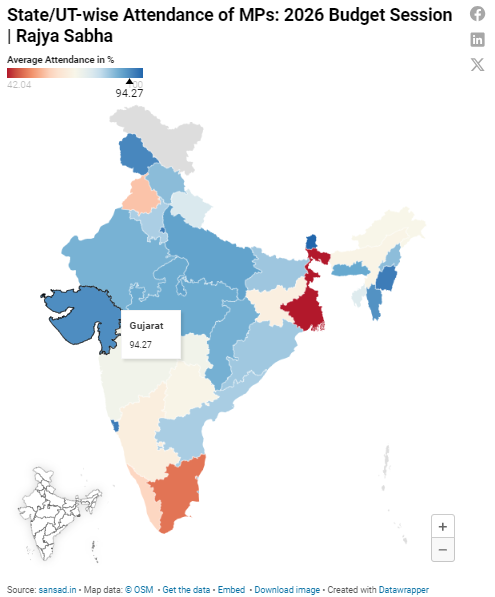
- NCT-Delhi clocked 99.67% average attendance (three MPs)- the highest among the States and UTs represented by more than one MP, followed by J&K (four MPs) averaging at 95.16% of the sittings;
- At the bottom of the pile in this category is West Bengal with 20 of its MPs averaging only 42.04% of the required sittings. Tamil Nadu’s 22 MPs averaged 49.55% which is still less than half of the required days of attendance.
Please read the attached report for other findings and the two MS Excel files for the attendance record of individual MPs.
Related Post
RTI reveals shocking details of Indian Prisoners languishing in Pakistan’s jails and also the worrisome phenomenon of soldiers who go missing on both sides of the border
Image courtesy: https://www.deccanherald.com/ May 26, 2023 By: Venkatesh Nayak According to recent
RTI reveals: GoI’s directions to block Twitter URLs and other social and digital media content soared in 2022
Readers may remember from earlier this week, a detailed write-up
